This summer near the end of June, I was stuck in a depression, lethargic, not a creative thought to be had. But around the edges of this danger/crisis there lurked a sense of opportunity for some kind of change. Over the years, I’ve learned that depression, for me, is usually un-mourned mourning, a resistance to doing the work of grieving. In this case, it was ecological grief for the many plants and animals that are disappearing, for the worldwide decline in biodiversity, for the war against Life by the present US government, and the destructive climate extremes we are facing.
In the garden, it takes the form of discouragement and pain at the scarcity of butterflies and insects. No matter how many native flowers we plant, fewer pollinators come to drink the nectar and eat the pollen. The garden is lush with flowers, but without the critters, I get lonely. The absence of their lively presence makes me sad. Unless I acknowledge the sorrow, it can sink into depression.
I believe deeply in the need to retrieve our senses and feminine embodiment to counter the thought-dominant, cold scientific objectivity that the patriarchy has ingrained in our culture and that is responsible, in large part, for environmental destruction. But my body’s emotional responses are often blocked by the grief and pain at what we are doing to nature.
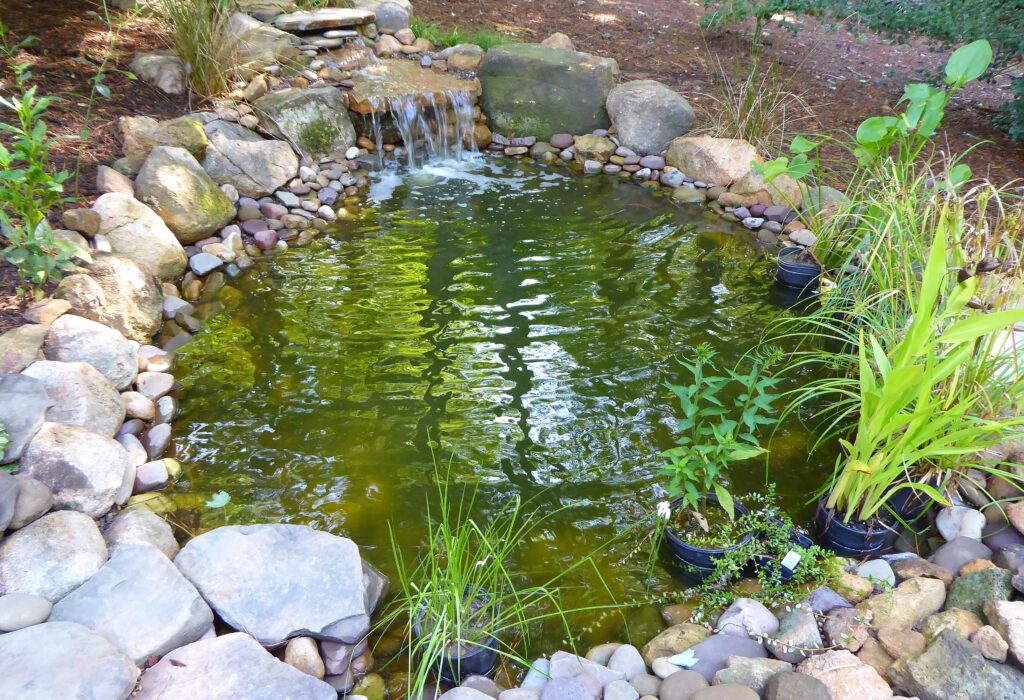
One morning in July, I’m standing at the railing on the back deck above the frog pond, taking turns croaking back and forth with the green frogs, whose voices, it is said, plunk like broken banjo strings. The gray tree frogs sound like they’re laughing, or is it cackling? We practice crazy pretend-laughing together.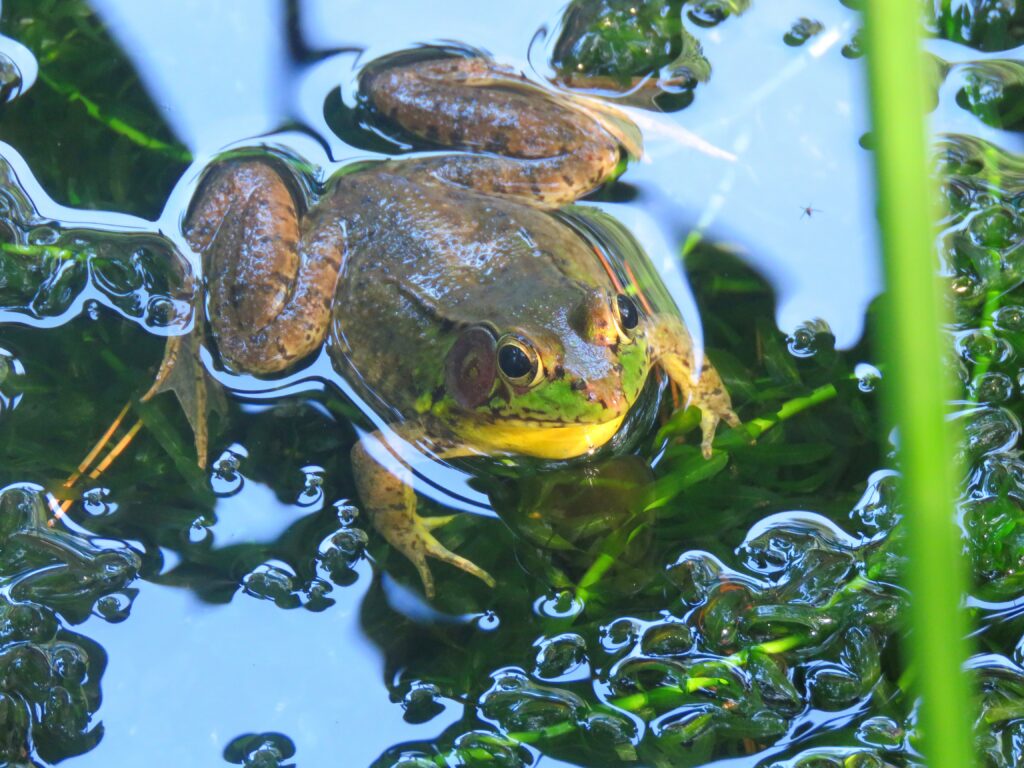
Suddenly a realization occurs—yes, we need to grieve the butterflies and all the other creatures we are losing, and, for their health and ours, we must passionately celebrate and enjoy everyone, every one, who is still here—the frogs and the birds, like the wood thrush with his enchanting song and the bluebirds who are nesting again. I/we must celebrate, give attention to, and enjoy what is still here.
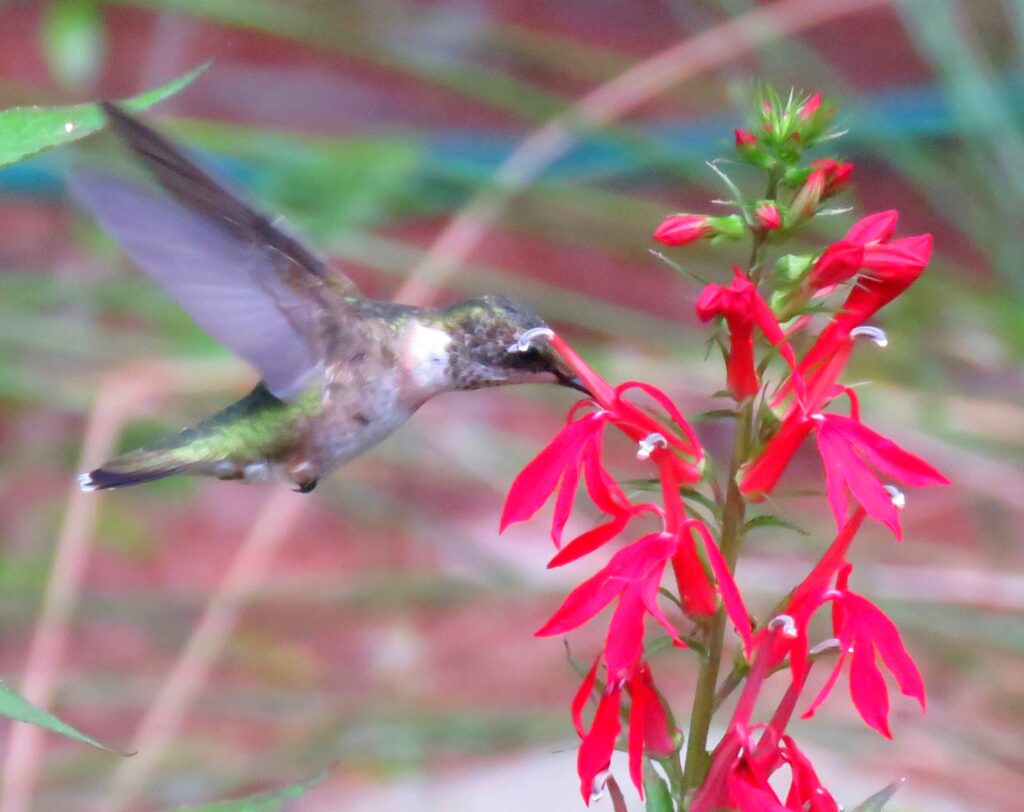
Ruby-throated Hummingbird
Just then, a female hummingbird (no red throat) comes to the feeder—only a foot away—sips a bit, then turns and faces me, close enough to touch. Slowly, never turning her body away, she slides right in front of me, looking at me intently. Then, still facing me, still eyeing me, she sidles slowly to the left, then to the right, and back to the left. She repeats this several times, as if to make doubly sure she has my attention.
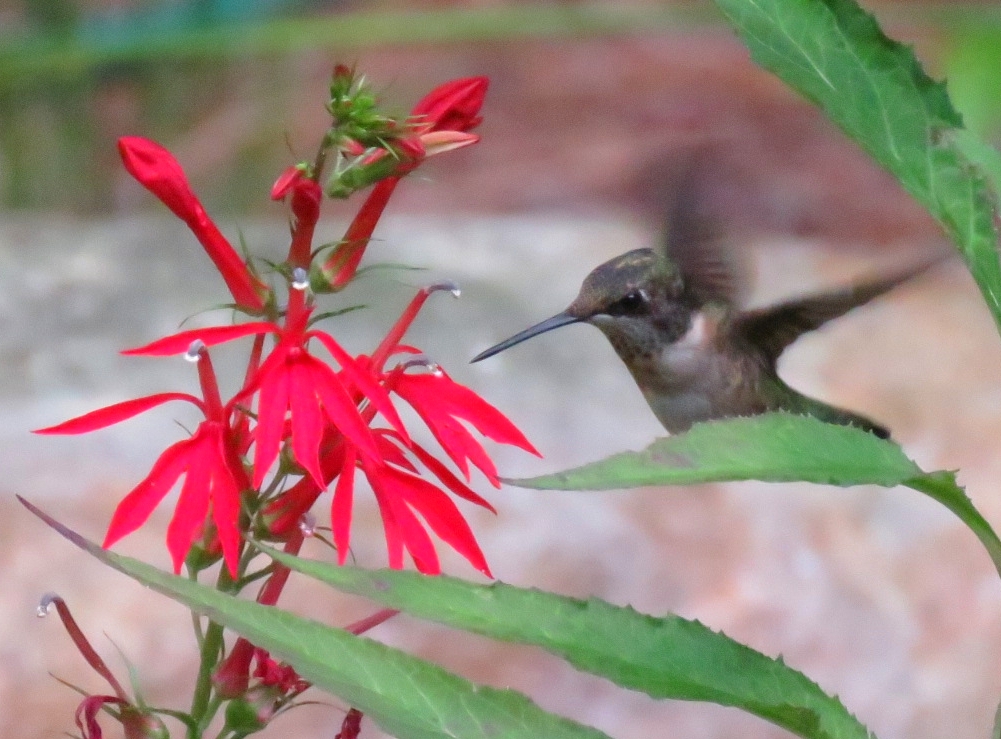
I feel a sudden burst of joy and laugh out loud, this time for real. It’s as if she had turned into a little person and did a sweet dance, saying, Look, you want to enjoy us? Well, here, enjoy me! A sense of ease and relief, like ice breaking away from my heart, stayed with me all day.
We can hold both—a teetering, ever moving, balance of pain and joy. The ability to feel joy makes it easier to allow grief to be there, too. It’s as if the joy and the pain are friends, no boundary between them. They are a continuum of primal human emotions that accompany our kinships with the plants and animals of the natural world, just as they do our relationships with other humans.
It’s important ecologically that we celebrate the critters so we have the energy to continue tending our gardens for them. Joy for the green frogs, the tree frogs, even the bully bullfrog. Joy for the birds, like the summer tanager and the hooded warbler who have returned. And the goldfinches busy eating seeds from the heads of flowers. Yes, there are a lot fewer birds now, but for the sake of their health and ours, we need to celebrate the ones who are still here so we can love them and stand up for them, rather than turning away to protect our hurting hearts.
Truth be told, even if most humans and most plants and animals were destroyed in what some people fear will be a collapse of life systems, those humans that are left would still have to form relationships with whatever life forms remained or new ones emerged, so we might as well practice—fervently—now.
Later, my husband, David, brought in the feeder to refill it and discovered ants at the bottom. Ugh. Juicy emotional mind switched to dry rational mind with the glum thought, oh maybe she was just confronting me to protest the condition of the feeder. I juggled these dualities, one a genial, right-brain, emotionally connective experience and the other a dry, left-brain, disconnecting analysis. Of course we need both, but these days thinking-about has prevailed over being-with.
The next morning, I am standing at the upstairs second-floor window looking down at the pond, when she rises up to the window, stops a foot away, facing me, looking at me intensely, as if to say, See, this has nothing to do with ants! Turn away from the doubt and return to faith in the goodness of what’s here, right in front of you.
I went out on the deck to journal this encounter and she came over, again just a foot away, looking at me as if to say, Good morning, then glided over to sip nectar from the cardinal-red beebalm flowers, each perfectly shaped for her long tongue. This whole interaction seemed like engaging in communication with another conscious, relational being.
When I told this story to a friend, he resonated with the enjoy/grieve theme and sent me this poem:
On Joy and Sorrow
By Kahlil Gibran (1883 –1931)
from The Prophet
Then a woman said, Speak to us of Joy and Sorrow.
And he answered:
Your joy is your sorrow unmasked.
And the selfsame well from which your laughter rises was oftentimes filled with your tears.
And how else can it be?
The deeper that sorrow carves into your being, the more joy you can contain.
Is not the cup that holds your wine the very cup that was burned in the potter’s oven?
And is not the lute that soothes your spirit, the very wood that was hollowed with knives?
When you are joyous, look deep into your heart and you shall find it is only that which has given you sorrow that is giving you joy.
When you are sorrowful look again in your heart, and you shall see that in truth you are weeping for that which has been your delight….¹
The Great Spangled Fritillary
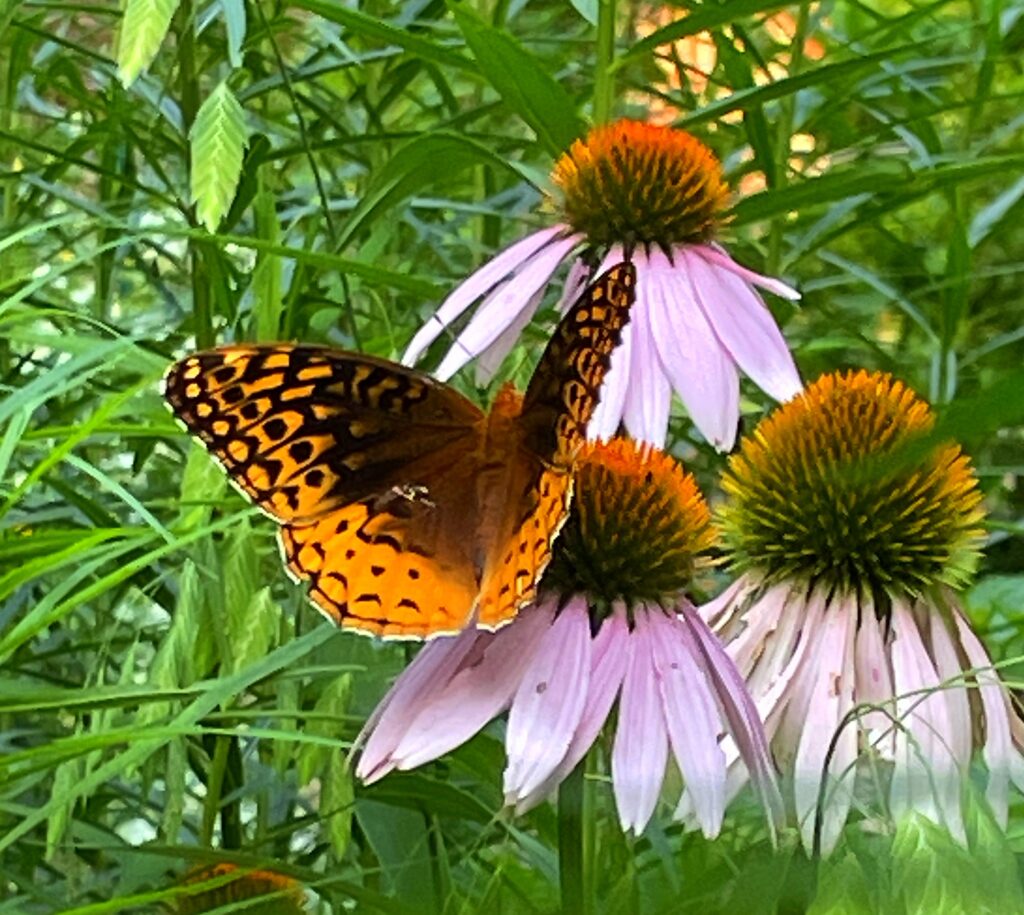
The next day, while doing a little work in the sunny side garden, we saw a gorgeous Great Spangled Fritillary butterfly, first sitting on a violet leaf, then moving slowly along the ground under the plant. It’s early in the summer now, but very hot. Usually, it’s late summer when these butterflies lay their eggs, singly, on violet leaves or in the leaf litter at the base of violet plants. Next spring, when the violets reemerge from their winter dormancy, the fritillary caterpillars emerge, too, eat the violet leaves, and grow into adult butterflies. Violets are the only plants they can eat. Because of this behavior, we knew she was a female. Otherwise, to our unskilled eyes, male and female would have been indistinguishable. So here I am, worried about the butterflies, and one appears with the message: yes, we butterflies are fewer now; we are in decline and to be mourned but, look, I’m still here, enjoy me now. Be present to me now.
One way to feel a greater sense of belonging to the place, to the Earth where you live, is to choose a species of wildlife and learn a bit about its ecology and maybe also its mythology, its earthy lifeways and its spiritual vitality. It was as if Life were emphasizing female. Again.
The Divine Feminine
Scientists gave this butterfly the name Speyeris cybele.
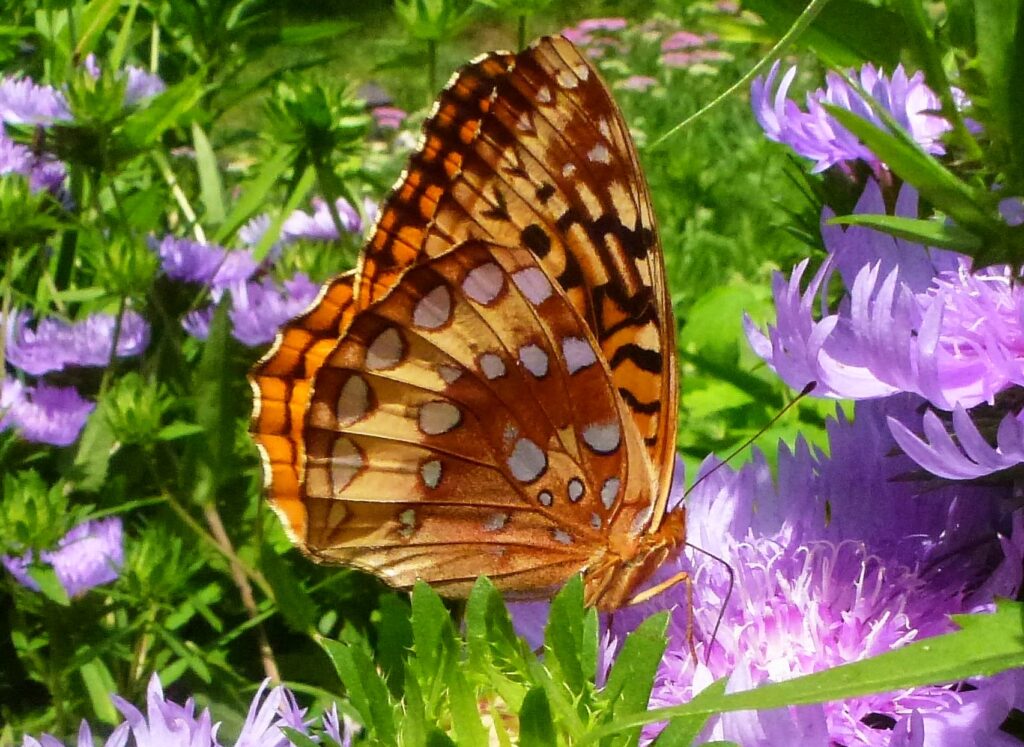
Cybele (pronounced Si-bi-li) is a Greek word that means “earth mother.” Cybele was a Greek goddess whose mythic presence is complicated, so admittedly picking and choosing, here is a bit about her:
In the mountainous landscape of Anatolia (Turkey), Cybele was the primal goddess of wild, untamed Earth and of fertility, worshipped with frenzied rites of ecstasy. When the cult of Cybele was adopted in Greece, she was associated with the Earth-goddess Gaia and with Rhea, called the “Mother of the Gods,” who was celebrated with robustious, ecstatic rites. She also became associated with the mother goddess of the harvest, Demeter.
In Rome she was known as Magna Mater or “Great Mother.” She was pictured holding a dish for making libations and a tympanum, a hand drum. Wiki says, “Literary sources describe joyous abandonment to the loud, percussive music of tympanum, castanets, clashing cymbals, and flutes, and to the frenzied ‘Phrygian dancing,’ perhaps a form of circle-dancing by women, to the roar of ‘wise and healing music of the gods’.” ²
Lest we think this association of a butterfly with a goddess is flighty, two sister species of fritillaries are S. aphrodite, named after the Greek goddess of beauty and S. diana, a Roman goddess, protector of wild animals and childbirth.
The Great Spangled Fritillary is common and widespread in the eastern US. When we encounter this butterfly may we be reminded that we, too, belong, as they do, to our local lands and to Mother Earth—Earth as Mother—who is with us and all around us. And to enjoy and celebrate our fellow creatures.
A day or so later, I had a session with a co-practitioner, Miranda, and she helped me clarify my question, which was, how shall I proceed with the hummingbird and butterfly communication received? She encouraged me to acknowledge the female theme and challenged me to trust rather than doubt what was given by Mother Earth, Madre Tierra; Mother of All, Madre Vida. Discrediting the authority of the Divine Feminine is what the patriarchy has sought all along. Miranda suggested I honor what nature has presented by writing this story. She confronted me, saying that in doubting the validity of writing about these encounters, I’m distrusting the Great Mother. How can I discount what she has given me to do? Because if I mistrust and dismiss what is given, I stop the flow of energy and convey a message to Life, to the inner Self, to the Creator with whom we co-create that I don’t value what’s imparted to me. She said that causing us to doubt the authority of the Great Mother has been the major project of the patriarchy, to divorce us, men and women, from our bond with her. In writing, I have never wanted to leave out other-gendered people by focusing on women. But let’s not let our minds be colonized by the patriarchy’s denial of feminine wisdom and empathic ways of knowing with the body, the senses, intuition, and right-brain powers of imagination.
So I go down to my studio, draw an imaginal circle of my spiritual guides and teachers around me for protection, and move—sillily, at first, laughing with the frogs, flopping, plopping around, shaking out the stiffness. I had felt so unsafe with all the forms of governmental destruction that are happening. But for now, the heartless cruelty they are causing can stay outside the circle of safety.
Asking the hummingbird if we can dance together, she says, as long as we dance with joy. Let’s try it! Move, letting sounds of delight emerge. And laugh, enjoying the subtle dance of being the hummingbird humming, with wings moving crazy fast. Breathing in and humming on each outbreath. The humming pitch changes depending on the speed of her wing beats. It is said that humming is good for us, it calms the nervous system. Still humming, put your hand on your throat and feel the vibration. Still humming, put your hand on your heart. The vibration of your voice is like a heart-massage! Direct your humming inward and experiment with different pitches and feel where they vibrate within your body. Take a long and full inbreath, exhale in a long and varied hum, humming love to your Self.
All life is energy, vibrating. Our humming becomes a song of solidarity for the hummingbirds, who are also in decline.
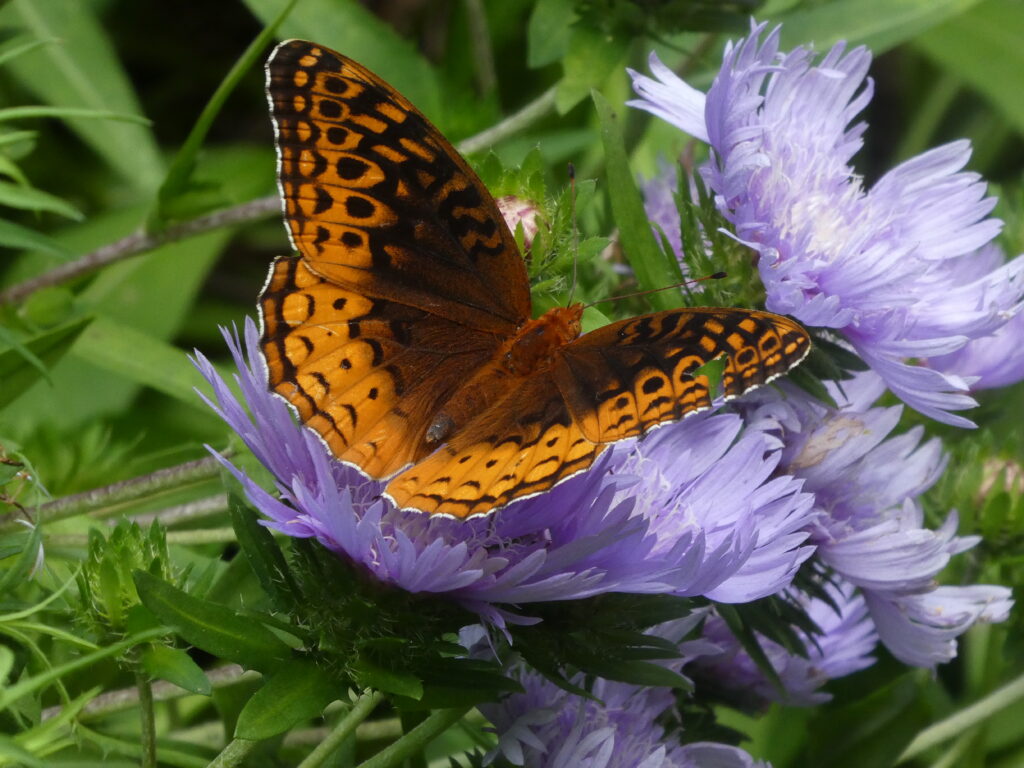
Asking the butterfly to dance, she says, as long as we dance honoring grief, delighting in beauty and in the beauty of grieving. Dancing as a butterfly, wings moving slowly and elegantly over to nectar on the elixir of purple coneflowers. Her dance is graceful and dignified. Her wings, our wings, encompass all pain in compassion.
The Greek goddess, Psyche, the goddess of the soul, is pictured in paintings and sculpture as a beautiful woman with butterfly wings, symbolizing transformation. Life becoming death becoming rebirth. The word psyche means “soul, life, and spirit” or “butterfly.” Oh, what Psyche endured for love!
Centering the feminine now, the needs of female animals’ breeding bodies and the needs of our own wild bodies, so we can continue to tend the gardens right along with the other wild ones. A wise friend said we can’t care for others unless we care for ourselves. Not wanting to leave out other-gendered people from this process of reconnecting with Earth and with our birthright to know that we belong to the Earth, we now invite the more masculine-identified ones among us to be in touch with their sensual, caring, relational selves and join the dance.
While dancing with the hummingbird and butterfly, I imagined creating a circle dance. I couldn’t think of a dance in the Dances of Universal Peace repertoire in which we became a bird or a butterfly, or one in which we danced with or as other animals. So I thought such a dance might be timely but seem weird.
There in my inbox was the July newsletter from Audubon with an article about Native American tribes dancing as birds, with videos of the Blackfeet Men’s Prairie Chicken Courting Dance, a Potawatomi Women’s Butterfly Dance, a Choctaw Bobwhite Quail Partner Dance, and a Pueblo Eagle Dance. Enjoy the link! ³
Come to think of it, it’s July when we have gone to powwows at David’s Ojibwe lineage reservation in Wisconsin. Here are some of their butterfly dancers.

Many Indigenous Nations are asking us descendants of the Euro-colonizers to reconnect with our indigeneity by loving and belonging to our places on Earth. It’s in our ancestry. The early European Goddess mythology and circle-dances were passionately in tune with primal Mother Earth. So let’s move as hummingbirds and with butterflies, dancing our prayers for their health and our continued joyful, soulful relationships with our earthy kin.
Notes
1. Kahlil Gibran, “On Joy and Sorrow.” This poem is in the public domain. Published in “Poem-a-Day” on February 10, 2019, by the Academy of American Poets.
2. Cybele – Wikipedia
3. https://www.audubon.org/magazine/its-powwow-season-watch-how-four-indigenous-dances-blend-tradition-birds-inspired-them
Photos are (C) BL and David Chaika
Marilyn McNamara
So wonderfully written! Thanks ever so much Betty Lou! Marilyn
BL Chaika
Thank you, Marilyn, for letting me know your enjoyed it!
Kathy Aalfs
Thank you so much for this enlightened message. It is so needed at this time! I love that it was timed to be in my mailbox today. Kathy
BL Chaika
Yes, Kathy. everyone’s loving voices, joining in community, are needed to rise above the exploitation and commodification of the Earth. Thanks for adding yours!
Steve Schlosnagle
Every day is Earth Day!
BL Chaika
Hey Steve, Earth honorer, so glad to hear from you!
Robin
I look forward to dancing birds with you!
BL Chaika
Yes, partner, you know the importance of embodiment for receiving messages and making heart-felt intuitive responses!
Lawrence Parent
Dragon’s breath and dreams –
I have seen a bed of roses turn to tears
Chapters ended in the dead of night
Their faces blank
A wretched sight
And sadness reigning in a set of fears.
And when the dawn fell through the window
On the sleep no dream would tread
The strained and ravaged spirits
Drank in the light instead
Of giving thunder all the blame
For waking spirits un the night
That came before the wonder
Of the dew in feathered flight.
But send for simple virtue
And call down the ancient star
For sharing is the key
To stop the bleeding of our hearts.
To blend amid a moment’s breadth
Our souls, though bittersweet,
Returning memories, vines clinging to our feet.
Happiness is easy
If you ask no more from life
Than the wisdom that comes
Gently,
There,
Between the pain and strife.
We find it in the nourishment
That lies behind the eyes
O tempered dragons
We must find and face
And conquer all their lies.
BL Chaika
Lawrence, thanks for this. It’s beautifully wise. Who wrote it?
bj
Thank you for including me in this beautiful and colorful and meaningful essay.
I have been going through many emotions this summer and have gotten joy from the many, many hummingbirds who have been lapping up the nectar from my feeders.
BL Chaika
Glad their message of joy has reached you, too, bj in return for tending them! We sure need it!
Barbara Stenross
I very much enjoyed this writing, and the gorgeous photos as well! Thank you for putting these words onto paper and sending them through the air to us, where I receive them as both grounding and inspiring.
One of my favorite books also explores the theme of grief, and in this case, praise. Martin Prechtel, the Smell of Rain on Dust.
BL Chaika
Barb, thanks for reading and for mentioning Prechtel’s Smell of Rain on Dust. He writes well and deeply on grief. You, being such a committed activist, understand the importance of both strength and hope!
Marjorie Marie
Dearest Hakima Betty Lou, this morning was the perfect time to enjoy your story! It is beautiful, deep, sad, joyous. I will go through my day with more intention because of these quiet moments with your writing. Thank you for being a great Earth steward and for sharing your thoughts ❤️
Marj Marie
Dearest Hakima Betty Lou, this morning was the perfect time to read your story. It is beautiful, deep, sad, joyous. Thank you for sharing your thoughts and wisdom. I will notice and honor every creature I meet today with a grateful heart.
BL Chaika
Marj, so good to hear from you! Expressing gratitude for the Life that is still with us was a hard lesson for me to learn when I read every day about all the ways countries are devaluing and crowding out nature. Thank you for joining me in loving the goodness that we are still a part of.
Laura Cotterman
This was so helpful for me, Betty Lou! (Came to me via Kathleen Hannan’s email) I’ve been struggling this summer with a lot of grief over climate chaos, loss of biodiversity, cruelty to fellow humans . . . all of it! Further, the extreme heat has made my usual gardening activities and woods walks less “pleasant.” You have reminded me that celebrating and witnessing all that is still here is crucial to my and others’ well-being. Thank you.
BL Chaika
Laura, thanks for letting me know the story was helpful to you. Yes, we all need to learn ways to manage all the grief we carry for losses of the natural world on so many levels. I have a lot of gratitude to Hummingbird and Fritillary for teaching me this loving, relational way.
Much gratitude, Laura, for all your work for our native plants!
Pamela St. John
Thank you so much for this beautiful article which came to me through Laura Cotterman.
The reminders of being present in the joy of all life here, now, as well as the message that our heart/ love is big enough to hold the seeming dualities of grief and joy as one are beautifully presented. A very lovely gift to us all.
BL Chaika
Nice to meet you, Pamela! Thank you for witnessing and amplifying that the love each of us holds in our hearts and collectively is great enough to contain the whole range of our emotions. I would add now that I believe we are aspects of and channelers of the Big Love that powers the universe.